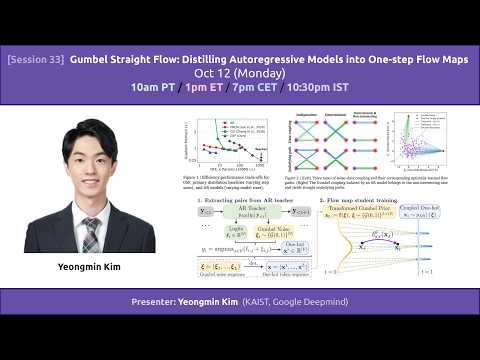
S33 | Gumbel Straight Flow: Distilling Autoregressive Models into One-step Flow Maps
Yeongmin Kim presents Gumbel Straight Flow, a continuous flow map language model that leverages the noise-data coupling of a pretrained autoregressive model. The authors show theoretically that the coupling between Gumbel noise and one-hot token sequences induced by an autoregressive model yields non-intersecting linear paths connecting the noise to the sequence representations, which is what makes few-step sampling tractable. GSF is trained with a flow map semigroup objective whose tangent condition is guided directly by the AR teacher, and it outperforms current few-step language generation baselines across pretraining and downstream benchmarks.
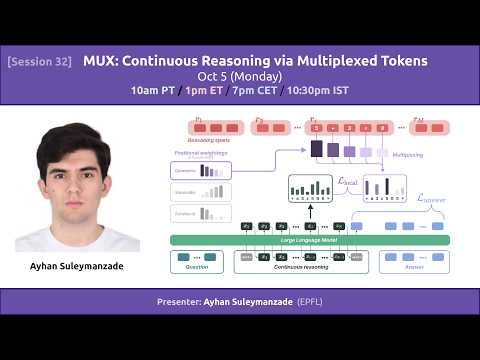
S32 | MUX: Continuous Reasoning via Multiplexed Tokens
Ayhan Suleymanzade presents MUX, which distills discrete chains of thought into continuous multiplexed tokens, where each latent token represents a weighted linear superposition of a span of reasoning subwords that is lossless by construction and fully recoverable. The authors prove that simple position-dependent weightings such as geometric decay support lossless multiplexing, which prevents the shortcut behaviors caused by latent collapse, and they show multiplexed reasoning can explore in parallel on search problems. Across 32 evaluation settings and four language models, MUX beats strong latent reasoning baselines.
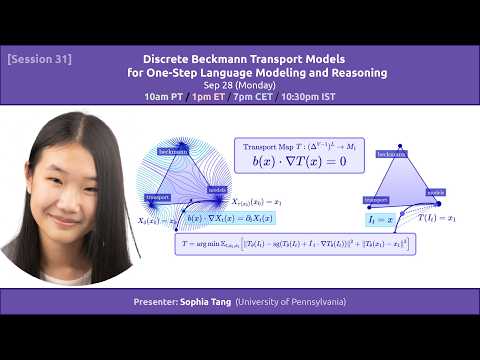
S31 | Discrete Beckmann Transport Models for One-Step Language Modeling and Reasoning
Sophia Tang presents Discrete Beckmann Transport Models, which reach one- and few-step generation in discrete flow models without distilling a pretrained teacher. DBTM builds on a time-independent flow whose autonomous transport map provably carries any point to a fixed point on the vertices of the simplex in a single step, a property characterized by a conservation equation whose residual is minimized directly from data. Generation then reduces to iterating one map until it reaches a fixed point, improving quality and accuracy over discrete diffusion and continuous flow baselines.
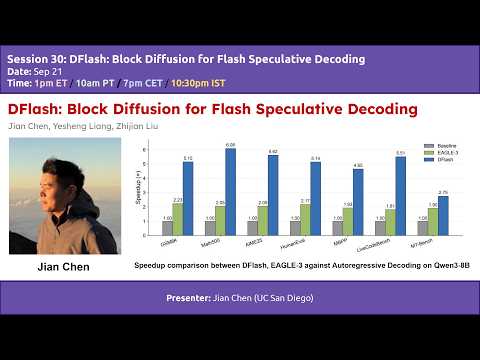
S30 | DFlash: Block Diffusion for Flash Speculative Decoding
Jian Chen presents DFlash, a speculative decoding framework that replaces autoregressive drafting with a lightweight block diffusion model, so all draft tokens come out of a single forward pass. Conditioning the draft model on context features extracted from the target model keeps draft quality and acceptance rates high. DFlash reaches over 6x lossless acceleration across a range of models and tasks, up to 2.5x higher speedup than EAGLE-3.
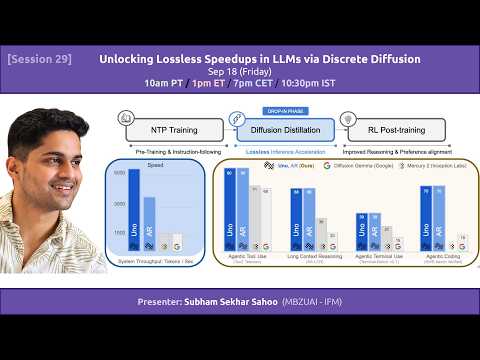
S29 | Unlocking Lossless Speedups in LLMs via Discrete Diffusion
Uno is a diffusion-augmented LLM that defines an autoregressive model distribution and uses diffusion to draw several tokens in parallel from that same distribution, so it accelerates generation without sacrificing the quality of the underlying AR model and needs no separate draft model. Uno beats leading speculative-decoding methods in throughput at every batch size and reaches up to 3x speedups over the base AR model, and the 8B Uno outperforms the 26B DiffusionGemma and the proprietary Mercury 2 on agentic tool use, coding, and long-context reasoning.
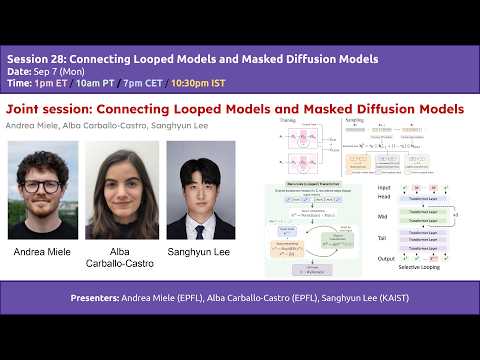
S28 | Connecting Looped Models and Masked Diffusion Models
A joint session on three concurrent papers that reuse the same transformer weights several times within a single denoising step, adding recursive depth as a third scaling axis for masked diffusion beyond parameter count and denoising steps. Alba Carballo-Castro (EPFL) presents Recursive Scaling in Masked Diffusion Models, Andrea Miele (EPFL) presents Fixed-Point Masked Generative Modeling, and Sanghyun Lee presents Looped Diffusion Language Models.
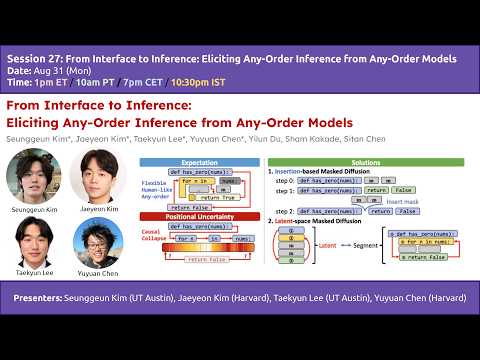
S27 | From Interface to Inference: Eliciting Any-Order Inference from Any-Order Models
Seunggeun Kim and Jaeyeon Kim show that the any-order prediction interface of masked diffusion models does not by itself deliver any-order inference, because fixed-canvas token-level models may know what semantic component should appear without knowing where to place it. They propose two fixes: insertion-based masked diffusion, which relaxes fixed-position commitments and generates across non-contiguous regions, and latent-space masked diffusion, which predicts coarser semantic segments and enables search over latent generation orders. A 7B FlexMDM for Python coding and a 125M LatentMDM for GSM8K both show distinct any-order inference behaviors and improved downstream performance.
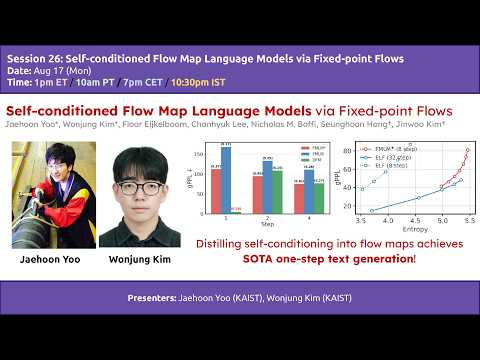
S26 | Self-conditioned Flow Map Language Models via Fixed-point Flows
Jaehoon Yoo and Wonjung Kim study self-conditioning in flow-based language models, where the model denoises text while conditioning on its own denoising estimate. They show that self-conditioning solves a fixed-point iteration that bootstraps the learned denoiser, and they use this view to define fixed-point flows, a two-dimensional class of self-conditioned flows spanning the flow process and the fixed-point iteration. Distilling both dimensions yields FMLM★, a flow map language model that outperforms state-of-the-art self-conditioned and few-step models in one- and few-step generation on OpenWebText.
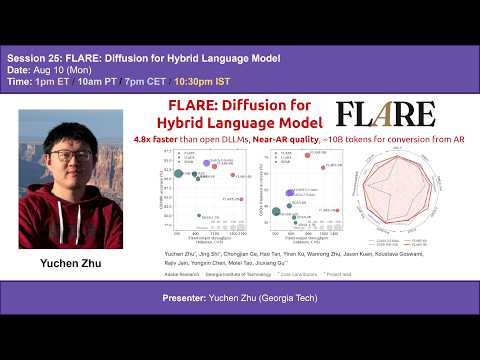
S25 | FLARE: Diffusion for Hybrid Language Model
Yuchen Zhu (Georgia Tech) presents FLARE, a framework that turns a hybrid-attention autoregressive (AR) LLM into one that also runs diffusion-style parallel decoding, so a single checkpoint supports both AR verified decoding and diffusion denoising. The authors find that transfer data quality, more than the loss formulation or attention-mask design, decides how much of the seed checkpoint's capability survives. Starting from strong AR checkpoints with limited post-training data, FLARE matches leading open-source diffusion LLMs across scales and delivers consistent throughput gains in single-GPU concurrent serving.
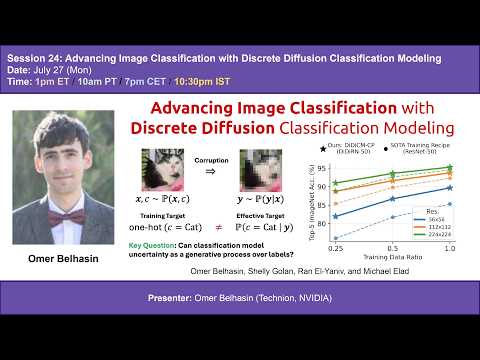
S24 | Advancing Image Classification with Discrete Diffusion Classification Modeling
DiDiCM reframes image classification as discrete diffusion, modeling the posterior over class labels conditioned on the input image rather than predicting a label directly. Running the diffusion over class probabilities or over discrete labels lets you trade compute against memory. A few iterations already beat standard classifiers on ImageNet, and the gap widens as inputs grow corrupted or training data scarce.
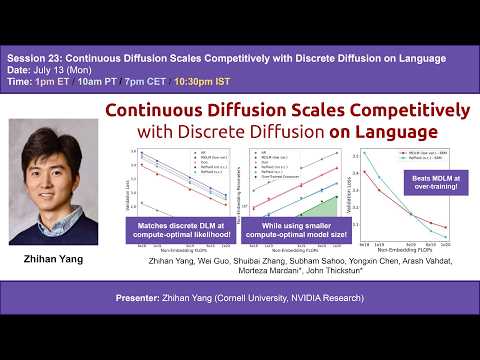
S23 | Continuous Diffusion Scales Competitively with Discrete Diffusion for Language
Zhihan Yang (Cornell) presents RePlaid, revisiting the Plaid continuous diffusion language model to challenge the view that continuous diffusion is less scalable than discrete diffusion. RePlaid needs only 20x more compute than an autoregressive model to match its perplexity, close to MDLM at 14x and far below the 64x once attributed to the original Plaid, and it reaches a state-of-the-art perplexity of 22.1 among continuous diffusion language models on OpenWebText.
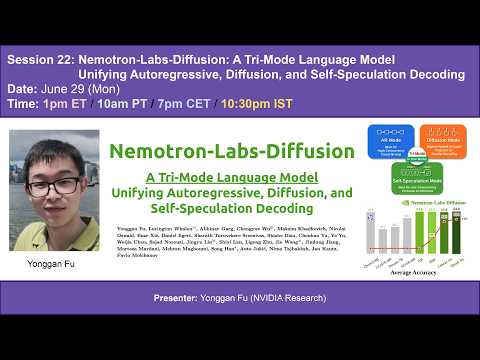
S22 | Nemotron-Labs-Diffusion: A Tri-Mode Language Model
Nemotron-Labs-Diffusion unifies autoregressive, diffusion, and self-speculation decoding in one architecture, trained with a joint objective so it can switch modes to keep throughput high. The two objectives prove complementary: diffusion improves lookahead planning, while autoregression supplies left-to-right linguistic priors.
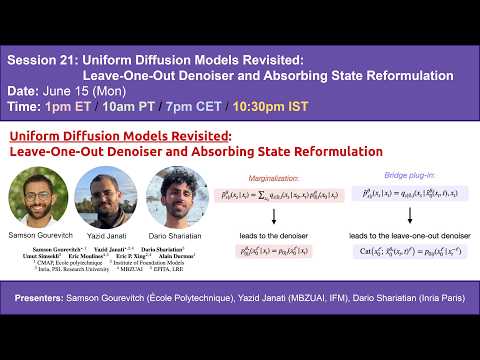
S21 | Uniform Diffusion Models Revisited: Leave-One-Out Denoiser and Absorbing State Reformulation
Samson Gourevitch (École Polytechnique), Yazid Janati (MBZUAI), and Dario Shariatian (INRIA) revisit Uniform Diffusion Models (UDMs) and show that their standard parameterization is trained by a leave-one-out posterior, which predicts each clean token without seeing its own noisy observation. Correcting for this mismatch improves UDM generation, and an absorbing-state reformulation matches masked diffusion, suggesting the gap between the two comes from parameterization and sampling rather than the choice of marginals.
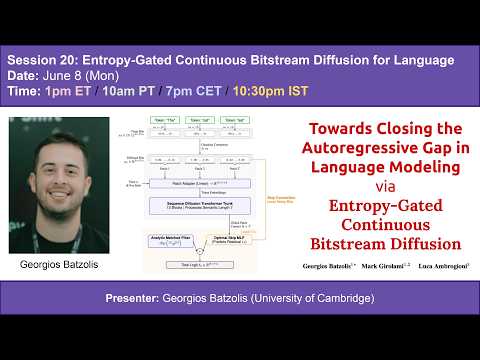
S20 | Closing the Autoregressive Gap with Continuous Bitstream Diffusion
Georgios Batzolis (University of Cambridge) presents a continuous diffusion language model that represents text as fixed-width binary bitstreams instead of token embeddings. An entropy-gated stochastic sampler concentrates randomness where token uncertainty is highest, which narrows the quality gap to autoregressive models, while the model predicts only O(log V) bits per token rather than a full vocabulary distribution.
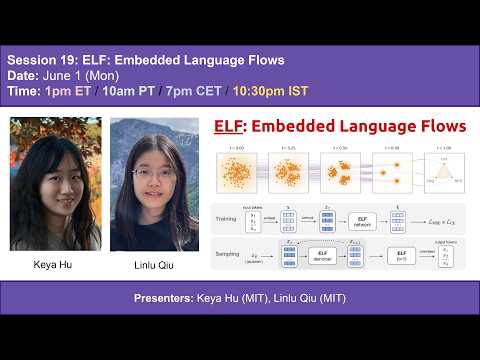
S19 | ELF: Embedded Language Flows
Keya Hu and Linlu Qiu (MIT) present ELF (Embedded Language Flows), a continuous diffusion language model that runs Flow Matching in continuous embedding space and discretizes to tokens only at the final step. This design makes it easy to adapt image-domain techniques such as classifier-free guidance.
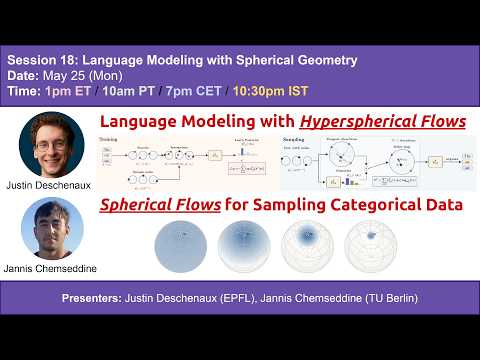
S18 | Language Modeling with Spherical Geometry
Justin Deschenaux (EPFL) and Jannis Chemseddine (TU Berlin) present their recent works on hyperspherical language modeling. By lifting tokens onto the sphere, they define language flows along SLERP and vMF paths. The vMF path admits a closed-form score, Hyperspherical flows improve code generation over prior flow language models, and at matched NFE, the PC sampler with vMF paths improves accuracy on Sudoku.
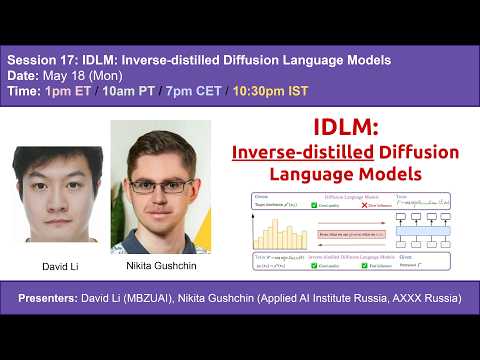
S17 | IDLM: Inverse-distilled Diffusion Language Models
IDLM extends Inverse Distillation to discrete diffusion language models, with a uniqueness theorem and gradient-stable relaxations that enable effective training, significantly reducing the number of inference steps while preserving the teacher model's entropy and generative perplexity.
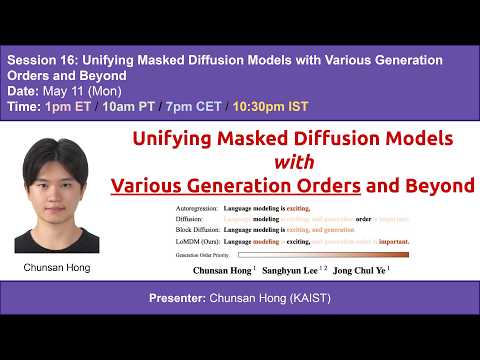
S16 | Unifying Masked Diffusion Models with Various Generation Orders and Beyond
Order-expressive masked diffusion (OeMDM) unifies masked diffusion, autoregressive, and block diffusion models in a single framework, and its extension LoMDM jointly learns the generation order and diffusion backbone end-to-end, outperforming prior discrete diffusion baselines on language modeling benchmarks.
S15 | Planner Aware Path Learning in Diffusion Language Models Training
Fred Zhangzhi Peng presents Planner Aware Path Learning (PAPL), a simple modification to the masked diffusion loss that aligns training with planner-based inference, yielding large gains on protein modeling, text generation, and code.
S14 | One-step Language Modeling via Continuous Denoising
Flow-based Language Models (FLMs) replace factorized ancestral sampling with sample-level continuous transport via flow matching, and can be distilled into a flow map language model that generates in as few as one step, matching 8-step discrete diffusion quality with an ~8.3× speedup.
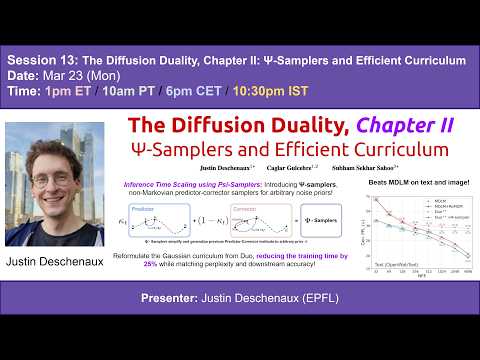
S13 | The Diffusion Duality, Chapter II: Ψ-Samplers and Efficient Curriculum
Justin Deschenaux presents a family of Predictor-Corrector samplers for discrete diffusion models that generalize prior approaches to arbitrary noise processes and, unlike conventional methods, continue to improve as the number of sampling steps increases.
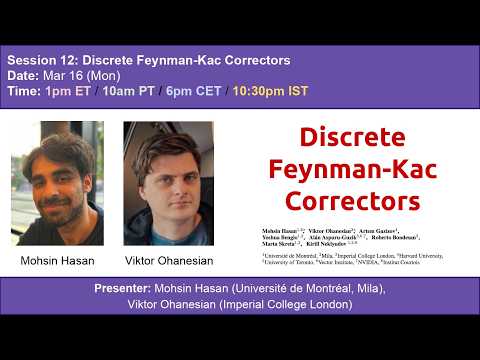
S12 | Discrete Feynman-Kac Correctors
Mohsin Hasan and Viktor Ohanesian present Discrete Feynman-Kac Correctors, a framework for controlling discrete diffusion sampling at inference time using Sequential Monte Carlo, enabling temperature control and reward-guided generation without retraining.
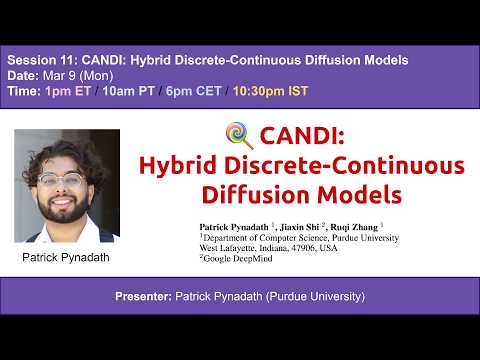
S11 | CANDI: Hybrid Discrete-Continuous Diffusion Models
Continuous diffusion dominates images and LLMs use continuous embeddings, yet discrete diffusion still wins for language. CANDI explains this via "temporal dissonance" and fixes it by keeping some tokens clean as anchors while corrupting the rest with Gaussian noise.

S10 | Reasoning with Latent Tokens in Diffusion Language Models
Andre He (LTI @ CMU) presents why latent tokens in diffusion language models enable planning and lookahead, and how similar multi-token prediction objectives improve autoregressive reasoning.
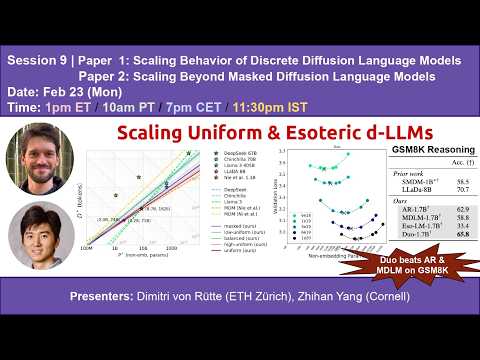
S9 | Scaling Discrete Diffusion Language Models
Dimitri von Rütte (ETH) and Zhihan Yang (Cornell) present two papers on scaling laws of discrete diffusion LLMs that challenge the dominance of Masked Diffusion.
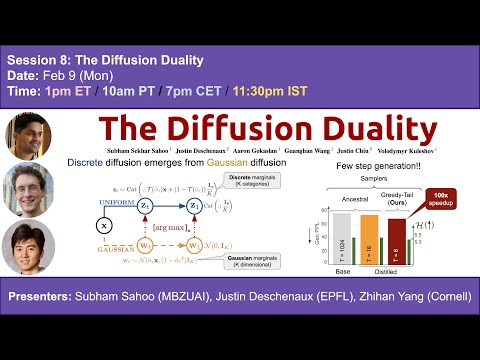
S8 | The Diffusion Duality
Today, Subham Sahoo (IFM), Justin Deschenaux (EPFL) and Zhihan Yang (Cornell) are presenting The Diffusion Duality (ICML 2025)
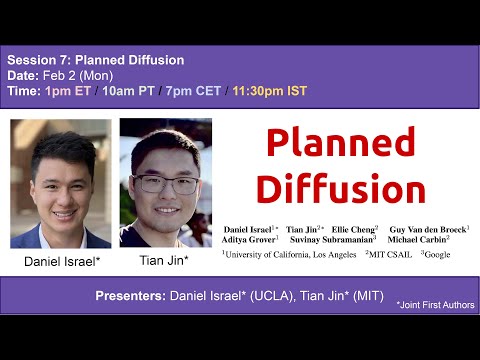
S7 | Planned Diffusion
Daniel Israel and Tian Jin discuss Planned Diffusion. Planned diffusion speeds up text generation by planning with an autoregressive model and then generating multiple spans in parallel with diffusion while keeping quality nearly the same.
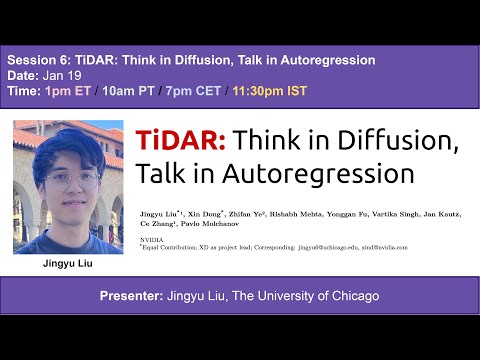
S6 | TiDAR: Think in Diffusion, Talk in Autoregression
Jingyu Liu will discuss TiDAR, a hybrid decoding approach that combines diffusion-style parallel drafting with autoregressive verification for high quality and high throughput.
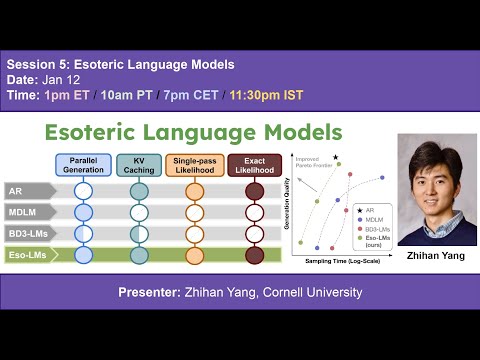
S5 | Esoteric Language Models
In this talk, Zhihan Yang presents Eso-LMs, which unifies AR and diffusion language models. Eso-LMs enable exact likelihoods and KV caching while preserving parallel generation.
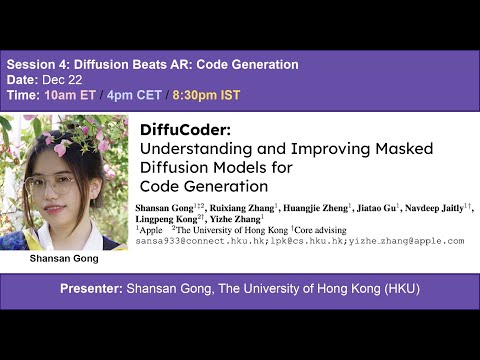
S4 | DiffuCoder: Understanding and Improving Masked Diffusion Models for Code Generation
In this talk, Shansan Gong will present DiffuCoder and discuss how diffusion language models enable global planning and iterative refinement for code generation.
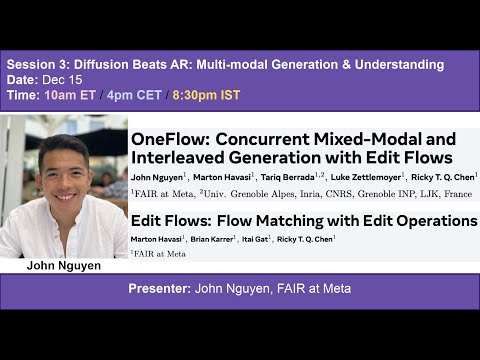
S3 | OneFlow: Concurrent Mixed-Modal and Interleaved Generation with Edit Flows
In this talk, John Nguyen presents OneFlow, a non-autoregressive multimodal model for concurrent text and image generation.
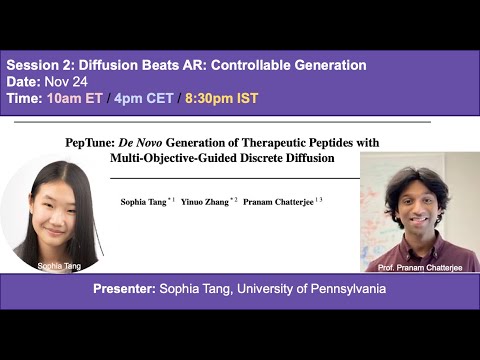
S2 | Peptune: De Novo Generation of Therapeutic Peptides with Guided Discrete Diffusion
In this talk, Sophia Tang shows how discrete diffusion enables more controllable and efficient molecule generation.
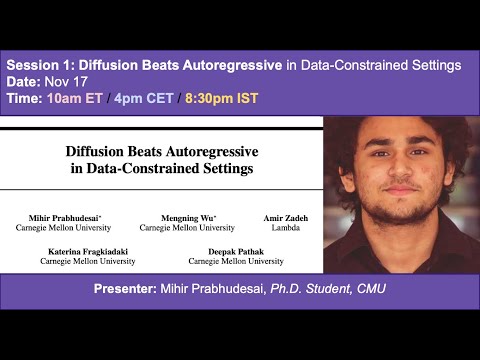
S1 | Diffusion Language Models beat AR in data constrained regime
In this talk, Mihir Prabhudesai shows that diffusion LLMs excel in such settings by extracting more information from limited data.