But How Do Diffusion Language Models Actually Work?
Jia-Bin Huang explores several ideas for applying diffusion models to language modeling
Most Large Language Models (LLMs) today are based on Autoregressive models (i.e., they predict texts in a left-to-right order). But diffusion models offer iterative refinement, flexible control, and faster sampling. In this video, we explore several ideas for applying diffusion models to language modeling.
Simple Guidance Mechanisms for Discrete Diffusion Models
Simple Guidance Mechanisms for Discrete Diffusion Models (ICLR 2025 video)
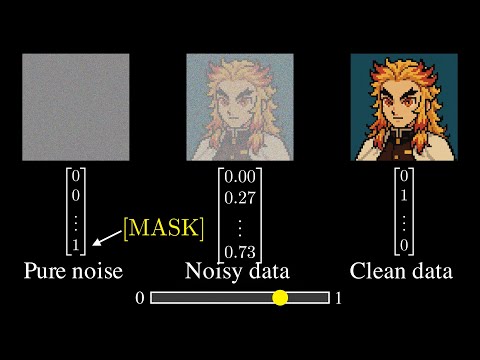
Diffusion models for continuous data gained widespread adoption owing to their high quality generation and control mechanisms. However, controllable diffusion on discrete data faces challenges given that continuous guidance methods do not directly apply to discrete diffusion. Here, we provide a straightforward derivation of classifier-free and classifier-based guidance for discrete diffusion, as well as a new class of diffusion models that leverage uniform noise and that are more guidable because they can continuously edit their outputs. We improve the quality of these models with a novel continuous-time variational lower bound that yields state-of-the-art performance, especially in settings involving guidance or fast generation. Empirically, we demonstrate that our guidance mechanisms combined with uniform noise diffusion improve controllable generation relative to autoregressive and diffusion baselines on several discrete data domains, including genomic sequences, small molecule design, and discretized image generation.
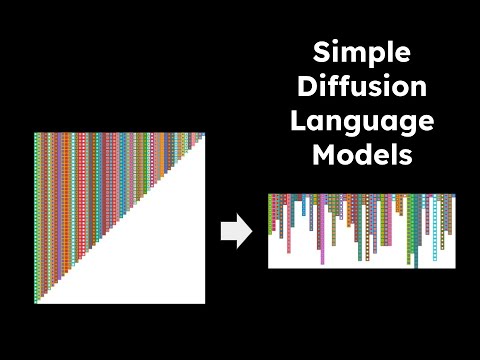
Simple Diffusion Language Models
Quick introduction to Masked Diffusion Language Models (MDLM) by Alexander Rush